
Key Points:
- While conventional lenses are best described via refraction, one can also consider them as components that impart a spatially varying phase shift on a wavefront and treat them with diffractive models
- Metasurfaces are a more recent development as part of a history of various phase-shifting elements including kinoforms, phased Fresnel lenses, and binary optics
- A metasurface lens, or metalens, imparts a spatially varying phase shift that enables the wavefront to constructively interfere at a target focal length
Overview
To better understand how metasurfaces work and how to design them, it’s instructive to walk through a simple example. In this brief article, we’ll describe metasurface lenses and how they operate compared to alternatives (e.g., refractives, Fresnel optics, and binary optics).
A lens is one of the most fundamental optical components. While conceptually simple (i.e., they take light and focus it to a point), there is much subtlety in how they are designed, their operating mechanisms, and their limitations. For a refractive lens (e.g., a plano-convex lens), one way of thinking about how the lens operates is via ray optics. In this formalism, a bundle of rays is incident on one side of the lens and at each material interface a given ray is deflected by some angle governed by Snell’s law. Depending on the incident angle of a given ray and the refractive indices of the incident and transmitted medium, this refraction angle will change. The purpose of the lens is to design the surfaces such that upon exiting the output surface of the lens, there will be a point at which these rays will all then converge to a single point (i.e., the focal spot located a focal length away from the surface).
Mapping the Lens Phase and Kinoforms
This description of how a lens operates is the primary basis of almost all modern lens design and lens optimization software (e.g., software such as Zemax, Code V, and alternatives). There are, however, other ways of describing how a lens operates. Instead of thinking in terms of rays, you can also regard light as a wave. What the lens represents then is a spatially varying thickness function, where the thickness is determined such that it will impart a spatially varying phase shift that enables the wavefront to constructively interfere at the focal spot. In thinking of the lens from this perspective, you can come to the realization that since phase is modulo 2π, the bulk of the lens appears to be wasting space—this is true in a sense, but for refractive optics this thickness is an important design parameter that cannot be neglected.
Because phase is modulo 2π, with a diffractive design we can eliminate the bulk of the lens and replace the lens with a surface that imparts the same phase function but in an ultrathin form factor. The tradeoff here is that this gives rise to chromatic aberrations, as this phase wrapping is tied to a specific wavelength. Historically, these have been implemented as kinoforms, elements that match the phase in a continuous manner modulo 2π. There are also approximations of kinoforms that leverage discrete phase steps that are referred to as binary optics. Within the past few decades, it’s become possible to realize these elements using metasurfaces, which are distinct from kinoforms in that the phase shift they impart is not proportional to their thickness function but rather a function of the scatterer geometry and its associated mode structure.
Metasurface Implementations
A metasurface lens, or metalens, operates by directly engineering the phase profile across a surface using an array of nanostructures, each one carefully designed to impart a specific phase delay on the incoming light. The desired phase shift at each point on the surface is derived from the optical path difference between the outer regions of the lens and the center, ensuring constructive interference at the focus.
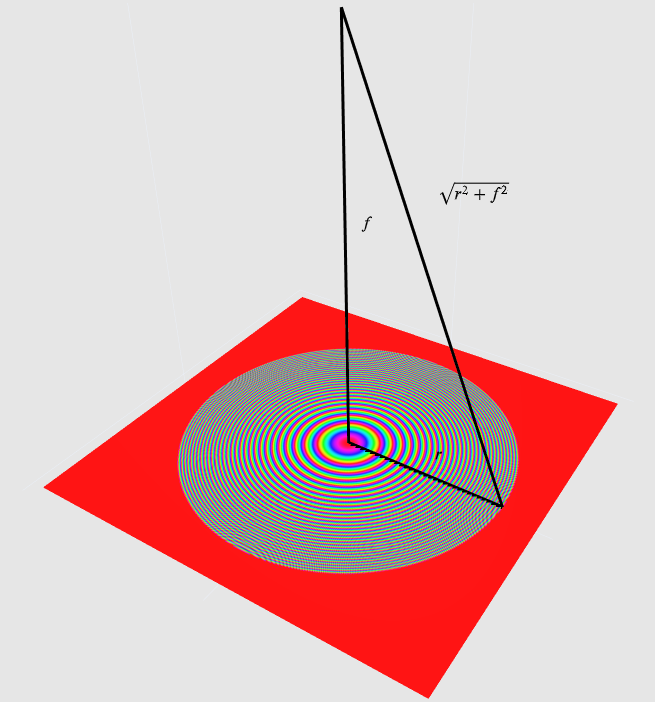
Consider a plane wave impinging on a flat surface. To focus that wave at a focal length f, the surface must apply a spatially varying phase φ(x, y) that compensates for the path length difference between the center of the surface and any off-axis point (x, y). This phase function is typically given by:
φ(x, y) = −(2π/λ)·(√(x² + y² + f²) − f)
This is just the phase delay necessary so that all secondary wavelets converge in phase at the focal point—a direct application of the Huygens–Fresnel principle. For small angles (or small apertures), this simplifies to a quadratic (i.e., parabolic) phase profile, which is often used as the design target for simplicity. For fast lenses, where the focal ratio f/D becomes small, this quadratic approximation can lead to substantial spherical aberrations and as such the functional form without approximation often provides superior performance from an aberration perspective in this regime.
Refractive lenses implement this phase delay via optical path length. Phased Fresnel lenses, Kinoforms, and metasurfaces all take this further by abstracting away bulk material and focusing instead on reproducing the necessary phase transformation as efficiently and compactly as possible. What distinguishes metasurfaces is the mechanism: rather than relying on accumulated path length through propagation, they locally engineer scattering behavior—each nanostructure acting like a subwavelength phase shifter tuned by its material, shape, size, and orientation. In practice, this means that at any given position on the metasurface, the desired phase is imparted by placing the scatterer design that most closely imparts the desired phase shift.
Summary
The benefit is often a dramatic reduction in thickness and weight, and a potentially higher degree of control over the output wavefront; however, this comes with tradeoffs. For one, metasurfaces are inherently narrowband unless explicitly designed otherwise, because their phase response is usually a function of wavelength in a nontrivial way. Additionally, since metasurfaces do not leverage bulk material dispersion in the same way as refractive optics, chromatic correction must be tackled through more advanced design techniques, often involving dispersion engineering at the level of the scatterer or by multiplexing multiple structures.
Still, as a basic example, the metasurface lens elegantly illustrates the principle that what a lens truly does is not “bend light” in the ray sense, but rather impose a spatial phase profile that manipulates how the wavefront propagates. For the case of a lens, the design goal is to ensure constructive interference at the location of the target focal spot.
Additional References
Goodman, Joseph W. Introduction to Fourier optics. Roberts and Company publishers, 2005.
Arbabi, Ehsan, et al. “Multiwavelength polarization-insensitive lenses based on dielectric metasurfaces with meta-molecules.” Optica 3.6 (2016): 628-633.
Aieta, Francesco, et al. “Aberrations of flat lenses and aplanatic metasurfaces.” Optics express 21.25 (2013): 31530-31539.