
Key Points:
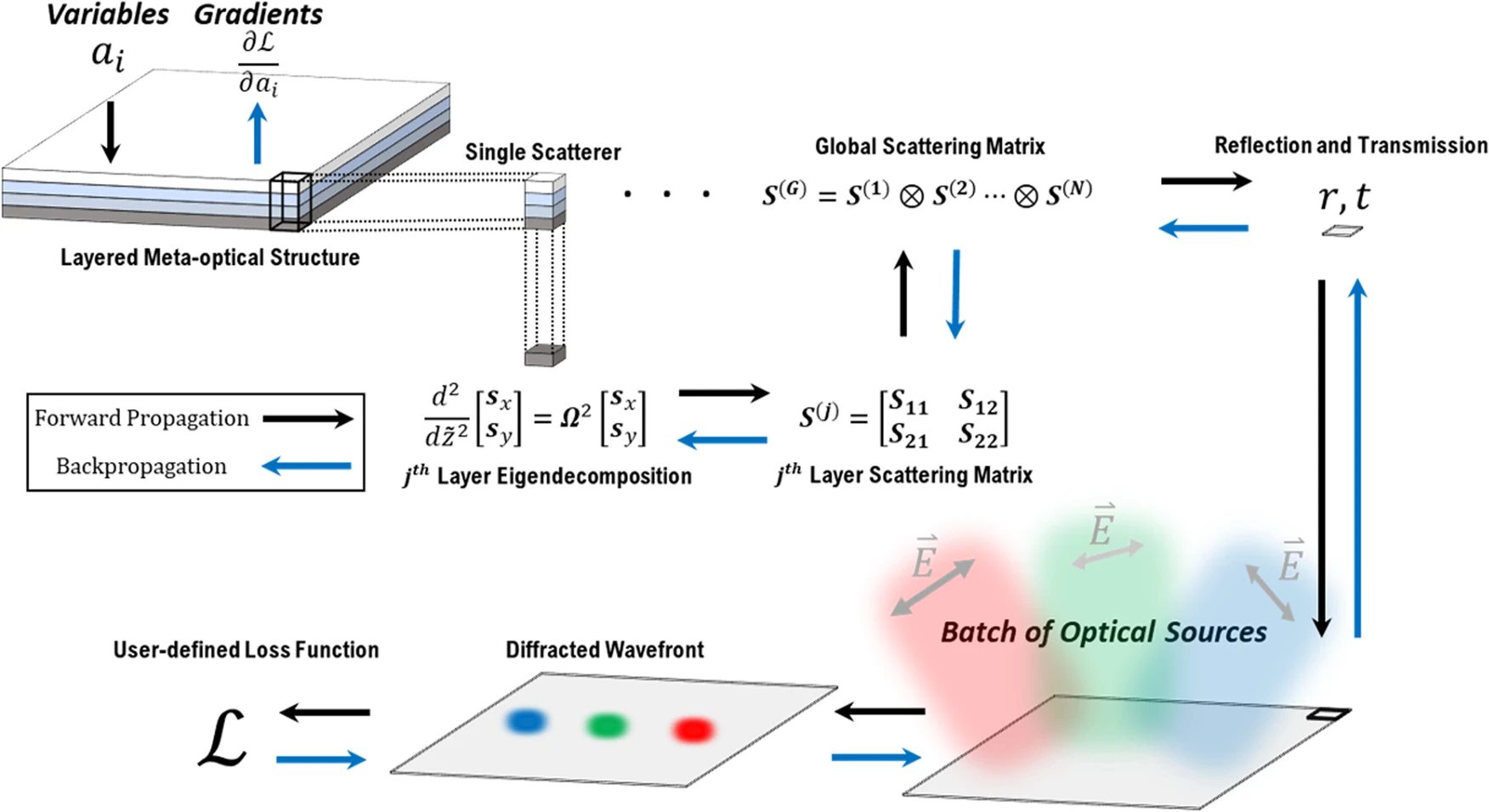
- Metasurface simulation typically entails a sequence of several different types of computational models to capture the physics at the scatterer level as well as across a full meta-optical surface
- Methods such as rigorous coupled-wave analysis (RCWA) and finite-difference time-domain (FDTD) work well for small systems but are impractical at most commercially relevant length scales where millimeter or centimeter-scale components are common
- Designers must select among a mix of different tools and should be aware of different model approximations to strike an appropriate balance between simulation accuracy and computational resources
The Basic Procedure
Metasurface simulation typically entails a sequence of steps utilizing different types of models and approximations. The exact procedure will depend on the target design, but here we will begin this discussion by focusing on a simple metasurface lens as an example.
Given the desired phase profile for a metasurface lens, a designer ultimately needs to generate a mask layout that will enable transfer of a pattern into a material that can impart the phase function onto an incident wavefront. Working backwards, the mask layout will comprise a set of shapes, often squares or circles, of varying dimensions. These will usually be placed on a regular, square grid, though hexagonal lattices are also common. This specific layout is inherently tied to a specific material and assumed thickness—without this information, the lens prescription is incomplete.
To arrive at this final mask, even with a desired phase mask known a priori, it often can be an iterative process between optimizing a scatterer design and aligning its thickness and pitch with the achievable nanofabrication processes of the equipment at the designer’s disposal. Assuming the material and its refractive index data is already known, the first step in the process is to simulate the scatterer for a given height and width.
This is typically accomplished either using rigorous coupled-wave analysis software or the finite-difference time-domain method with a periodic boundary condition. In either case, it’s assumed that we have a periodic grating that extends to infinity. This enables us to compute the transmission or reflection coefficient (both amplitude and phase) and we then usually perform a parameter sweep to determine these coefficients as a function of the geometry (e.g., with respect to the scatter width and height).
The Local Phase Approximation
Armed with this transmission coefficient data as a function of the scatterer geometry (i.e., a lookup table), and given the phase mask known a priori, one simply needs to assign to each position in the phase mask the geometry from the lookup table. This procedure is relatively straightforward, but there are some issues inherent to the process. The primary issue is the fact that we assumed in our scatterer simulation that it was a periodic grating, but then when we assign the geometries to each position in the phase mask, we immediately violate this as the phase is not constant as a function of position.
Is it okay that we do this? Yes, it is okay that we do this but only under the right conditions. This simulation approach is called the local phase approximation. It assumes that as long as the geometry of the scatterers varies slowly as a function of position, the transmission or reflection coefficient will remain approximately the same. This is easily evaluated by examining the case where you maintain the geometry over a neighborhood of increasing size (e.g., a 3×3, 5×5, or 10×10 grouping of scatterers). Similarly, if the geometry varies slowly even for adjacent scatterer sites, the transmission coefficient will remain similar.
Complications
It’s critical, however, that the change in geometry be “slow”. What “slow” is will depend on the application and there is not a universal answer to this, but it has been demonstrated multiple times in the literature that metasurfaces exhibiting higher phase gradients (i.e., the geometry changes more rapidly with position), equivalent to a higher NA for the case of a lens, have lower diffraction efficiencies.
Similarly, it has been shown in the literature that metasurface materials with higher refractive indices are capable of supporting higher phase gradients—the typical intuition behind this is that higher index materials will more tightly confine modes to being within the nanostructure itself, limiting the overlap of evanescent tails with those of neighboring posts such that inter-scatterer coupling is mitigated. Once the layout is generated via this local phase approximation, one can then validate the approach rigorously using finite-difference time-domain (FDTD) software, though this is only realistic for metasurface designs on the order of 10’s to 100’s of microns in size or smaller (for visible wavelengths), even with state-of-the-art GPU-accelerated design frameworks such as Tidy3D offered by FlexCompute.
Why do we design metasurfaces this way?
Why do we do this? This has more to do with the limitations of existing simulation models and design algorithms than anything else. If, for example, FDTD software were orders of magnitude faster and could simultaneously support orders of magnitude larger metasurface structures, it would not be necessary to simulate a scatterer with a periodic boundary condition, assume a local phase approximation, and then use a lookup table—one could simply simulate the entire metasurface at once and utilize one of several optimization algorithms to arrive at the necessary geometry distribution or device topology that provides the best performance.
For many practical applications, it’s necessary to simulate metasurfaces that are substantially larger than 10’s to 100’s of microns, with lenses for consumer electronics typically being on the order millimeters, and for other use cases for automotive or satellite-based systems, lens apertures on the order of centimeters to 10’s of centimeters are not uncommon. These are far beyond the capabilities of any existing FDTD tool without requiring many terabytes of memory and potentially years to decades to simulate, especially considering that optimizing metasurfaces often entails many 1000’s of simulations of a device with small perturbations to its design per iteration in order to maximize performance.
The need to balance accuracy and simulation speed
As such, metasurface designers often only use FDTD tools for small designs for initial validations of scatterer behavior and then rely on Fourier optics methods to simulate much larger lenses. In Fourier optics, one usually takes the electric field distribution of the metasurface (again calculated based on the local phase approximation) and then utilizes a technique called the angular spectrum method to propagate the electric field to the desired destination plane (e.g., the focal plane or some other image distance). Angular spectrum calculations are quite general, the primary assumption is that the electric field is a scalar field. If your electric field is paraxial, you can resort to even simpler techniques such as Fresnel diffraction or Fraunhofer diffraction if you only need far-field data.
Fourier optics is a powerful methodology that enables simulating much larger structures; however, it abstracts out the physics of the scatterers, assuming that they operate as idealized and isolated phase shifters that perfectly impart the prescribed transmission or reflection coefficient from the designer’s lookup table. Given these limitations, it’s necessary for designers to exploit a variety of tools, both FDTD and Fourier optics based and otherwise, to evaluate performance in different physics regimes.
Additional References
Yang, Jianji, and Jonathan A. Fan. “Analysis of material selection on dielectric metasurface performance.” Optics express 25.20 (2017): 23899-23909.
Pestourie, Raphaël Jean-Marie Fernand. Assume your neighbor is your equal: Inverse design in nanophotonics. Harvard University, 2020.
Tseng, Ethan, et al. “Neural nano-optics for high-quality thin lens imaging.” Nature communications 12.1 (2021): 6493.
Goodman, Joseph W. Introduction to Fourier optics. Roberts and Company publishers, 2005.
Colburn, Shane, and Arka Majumdar. “Inverse design and flexible parameterization of meta-optics using algorithmic differentiation.” Communications Physics 4.1 (2021): 65.