

Key Points:
- The point spread function (PSF) characterizes an optical system’s response to a point source of light and provides information relating to the resolving power and achievable image quality. Typically, optical engineers want to minimize the size of the PSF to match that of the diffraction-limited focal spot.
- Other types of PSFs with more complex spatial features, multiple lobes, or rotating foci can bring system-level benefits (e.g., enabling capture of more advanced spatial, spectral, and depth content, while potentially facilitating reduced tolerancing requirements though depth of focus extension).
- Metasurfaces offer a capable platform for engineering more complex PSFs owing to their subwavelength period, high degrees of freedom, support for freeform and asymmetric phase functions, and their ability to multiplex across lightfield parameters (e.g., polarization, wavevector, and frequency).
- While PSF engineering can bring tangible benefits, optical designers need to carefully consider the impact of any modified PSF design on system performance, including MTF attenuation, as in some cases it’s necessary to include additional postprocessing to imaging pipelines to extract the desired information encoded in a PSF.
Overview
For imaging lenses, it’s common for optical engineers to optimize these systems to minimize the spot size, wavefront error, and other related metrics. These are often useful proxies for resolution; however, there are situations where having a focal spot that exhibits multiple lobes, hotspots, or extended tails of intensity can have system-level benefits in terms of tolerancing and integration complexity, image quality following digital postprocessing, and enhancements in terms of extracting additional information (e.g., depth and spectral content).
A useful framework for approaching such problems is the body of work on point spread function engineering with diffractive optics, a methodology for which metasurfaces are very well suited. In this article, we’ll discuss point spread function engineering with metasurfaces, providing intuition on this methodology, discussing applications, and detailing some of the challenges and opportunities in the space. We describe some of the broad strokes in this post; some of the target use cases in the subsections here will be subjects of deep dive articles in the future.
What are Point Spread Functions?

One standard way of characterizing how well a lens can focus light down to a “point” is through its point spread function. Simply put, this function provides information about how a lens responds to a point source of light positioned at the object plane. In imaging systems, the point spread function (PSF) is a standard means of characterizing performance. If a PSF is “large” and spatially distributed, this results in blurred out features in an image, whereas if the PSF is tightly confined to a small spot (i.e., is close the diffraction-limited focal spot in size), then image content tends to be much sharper and higher contrast.
In Fourier domain, the PSF is called the Optical Transfer Function (OTF), the magnitude of which is the modulation transfer function (MTF). The MTF often looks like a curve that starts at one at zero frequency and then decays as spatial frequency (i.e., line pairs per millimeter) increases. Essentially, you can think of the MTF as representing how efficiently spatial frequency information from an object is transferred to an image. This is why optical designers often emphasize MTF and aim to exceed certain MTF values out to a particular spatial frequency, which dictates how well a lens system can resolve corresponding features on an object.
The point spread function is the 2-D analogue of the impulse response, which is used to characterize 1-D linear time-invariant systems in signal processing. With a PSF and a known object, the image can be expressed a convolution of the PSF and object. It matters whether the system is coherent or incoherent. When coherent, the PSF is complex valued, whereas for an incoherent system, the PSF is only an intensity function without any defined phase. The incoherent PSF is equal to the modulus squared of the coherent PSF.
While lens designers often want to make the PSF as compact and tightly focused as possible, there are some situations, however, where having a more spatially extended PSF is actually advantageous. A common example of this is in extended depth of field imaging, where Cathey and Dowski famously demonstrated in the 90’s how a diffractive optical element that imparts a cubic phase enables formation of a PSF that is highly insensitive to defocus aberration. In systems where it’s necessary to image over an extended depth range, or where positioning tolerances during camera assembly are very coarse and may lead to image defocus errors, addition of this type of phase mask could be beneficial. While images formed with this type of system are partially blurred, digital processing of the image via deconvolution can restore image sharpness, subject to some limitations that we’ll touch on later in the article.
There are other types of PSFs that are useful. For example, helical PSFs that convey depth information, PSFs for edge detection and image processing, and PSFs that can mimic convolutional kernels as used in neural networks.
How can Metasurfaces Help?
To generate these PSFs, it’s necessary to impart a phase function that in general may be asymmetric and rather complex, often exhibiting a variety of ripples and discontinuities in phase. As such, these profiles can be challenging to realize using conventional means via a sag profile, as the required surface morphology can be very complex and expensive to manufacture. Diffractive elements such as binary optics are a potential option for implementation, but the pitch of these elements is larger than the wavelength, limiting the achievable phase sampling. Spatial light modulators offer flexibility in implementing a wide range of different PSFs; however, the pitch of these devices is usually a few microns at the lowest, again constraining the achievable phase profiles to those with lower gradients.
With a metasurface platform, the subwavelength sampling offers more degrees of freedom and enables higher-resolution (i.e., higher phase gradient and higher NA) PSFs with complex features. There are some potential tradeoffs, and designers must contend with the efficiency and stray light limitations of metasurfaces, but with careful design, the enhanced degrees of freedom offered by metasurfaces can bring tangible benefits to point spread function design that are difficult and more expensive to achieve with other platforms.
How to Modify the PSF? 4f Systems or Utilizing a Single Metasurface?
There are different means of modifying the point spread function of an optical system when considering utilizing a meta-optical component. One standard means, as with other types of PSF engineering, is to insert the modifying element at the entrance pupil, or a plane conjugate to it, such as a Fourier plane of a 4f lens system. For example, when a cubic phase mask is inserted at the the Fourier plane of a 4f system, it produces an Airy beam that exhibits a large degree of propagation invariance. This property enables the misfocus insensitivity formulated by Cathey and Dowskey in their seminal paper on extended depth of field design.
The 4f approach necessitates three optical components (i.e., the two Fourier lenses in the 4f system, and the phase-shifting mask at the Fourier plane). With a metasurface, it’s straightforward to include the phase-shifting mask in the same profile as that of the lens. This enables including both a power term and wavefront coding term in a single surface, which can facilitate reducing system form factor and the number of optical surfaces required. Note that other types of diffractive optical elements can also do this, but due to their coarser pitch, it is more challenging in practice because of the limitations on achievable phase gradient and NA when these separate phase profiles are superposed.
Note that in some wavefront coding systems, you place the element at the exit pupil, which in some cases will coincide with the plane of the entrance pupil. Placement at the exit pupil is less common as this does not guarantee the same wavefront is imparted on different field angles.
Extended Depth of Focus

A prominent use case for PSF-engineered meta-optics is for extending depth of focus. For any focal system, there is a longitudinal range over which it can be considered to be “in focus”. This is proportional to the f/#, with higher f/# (i.e., larger focal length relative to aperture size) providing a longitudinally elongated focal zone. In an imaging content, this enables capturing object details over a wider range of distances about the imaged object plane, which can be useful in microscopy for imaging over extended depths in volumetric samples. For infinite conjugate camera systems (i.e., the lens is positioned a focal length away from the sensor), most of the time this has a minimal impact on the object range that is resolvable as the object distance tends to be very large relative to the focal length; however, it can substantially relax back focal length alignment tolerances when the depth of focus is enhanced by a small factor, potentially eliminating the need for costly active alignment procedures during camera assembly.
There are also use cases in projection systems (e.g., semiconductor lithography or metrology systems), where an incident beam must be well focused at a particular plane. With conventional lenses, you are constrained to having a depth of focus that is usually a small multiple of the wavelength, usually on the order of a few microns or less for visible range systems. This leads to more costly alignment and maintenance procedures and more expensive optical components to meet these stringent requirements. With an extended depth of focus meta-optic, it’s feasible to increase this depth of focus by 2X to 100X.
Bear in mind that in extending the depth of focus, you will attenuate the MTF to some degree. You cannot arbitrarily extend the depth of focus without making sacrifices elsewhere. That being said, in certain applications the benefits of an elongated focus can outweigh the costs.
Circumventing Metasurface Chromatic Aberration

Meta-optics with an extended depth of focus (EDOF) also present a means for circumventing chromatic aberration when combined with computational imaging software. While an EDOF meta-optic will still exhibit a chromatic focal shift, a designer can engineer the point spread function to be invariant across a continuous band of wavelengths. This enables utilizing such an EDOF meta-optic to “encode” object information into a blurred image, where the blur is an engineered feature rather than a drawback. Then, paired with a priori information about the PSF (e.g., via measuring and calibrating the PSF in the lab), one can use deconvolution software to invert the blur and recover a sharp image of the object.
Note that deconvolution cannot be applied with success with a standard meta-optic that is designed to focus down to a diffraction-limited spot, because in that case the PSF is highly dependent on wavelength and image content at off-design wavelengths becomes so blurred that it is not recoverable. Software cannot recover information that is not encoded or that is lost to noise.
With this in mind, there are a few key design considerations with this approach. Signal-to-noise ratio (SNR) is critical and is related to the modulation transfer function (MTF) of the system. In extending the depth of focus to accommodate a wavelength-invariant PSF to enable achromatic computational imaging, the MTF will be attenuated as mentioned earlier. With appropriate design though, the spatial distribution of the PSF will enable an MTF that is attenuated but without any zeros out to the cutoff frequency. This is a key insight. If the MTF decays to zero, spatial frequency information is lost and it cannot be recovered, but if the MTF is nonzero and high “enough”, then deconvolution is a viable means for reconstructing an image. What is “enough” depends on the application and is intimately connected to SNR. Essentially, if the signal is of comparable order to the noise (e.g., sensor readout noise and/or shot noise), then it is unlikely to be of much use. In practice, an MTF of 10% is usually a workable benchmark for high-fidelity recovery of a scene, but this will depend on the reconstruction algorithm, image quality requirements for the target use case, etc.
Depth and Spectral Engineering

Another use case for PSF-engineered meta-optics is to encode other types of scene information beyond just spatial information. This can include both depth content and spectral information. A prominent example of a type of PSF that facilitates this is a double-helix PSF. Originating from research in the 90’s and early 2000’s on propagation-invariant beams, a double-helix PSF exhibits two distinct focal spots that rotate in plane as a system is brought in and out of focus. This rotating behavior comes about from a specific superposition of Laguerre-Gaussian modes generated by the phase mask. This PSF’s behavior is powerful in that the orientation angle of the two foci can serve as a readout of the level of defocus, which ultimately conveys information about the distance of objects in a similar manner to depth from defocus cameras.
A key advantage that double-helix PSFs exhibit compared to traditional depth from defocus cameras is that it is far more sensitive to changes in defocus owing to the spatial frequency content of the PSF. With a traditional clear aperture lens, the PSF changes rapidly about the focal plane and then becomes highly defocused the further back you translate, making it difficult to infer distance information over a wide defocus range. A double-helix PSF by contrast can maintain sensitivity over a much wider range.
While double-helix PSFs have primarily been used to encode depth information, most often in microscopes, this form of rotating PSF can also be used to encode spectral information. In particular, with a meta-optic platform in which the metasurface includes a power term, owing to its inherent chromatic focal shift, a metasurface that simultaneously imparts the phase mask for a double-helix PSF enables a wavelength sensitive PSF that can enable reconstruction of spectra from imaged point sources. This has been demonstrated experimentally in the infrared range, but in principle can be adapted to other wavelength ranges with appropriate adjustments in materials, apertures, and the detector material stack.
Convolutional and Computational Optics
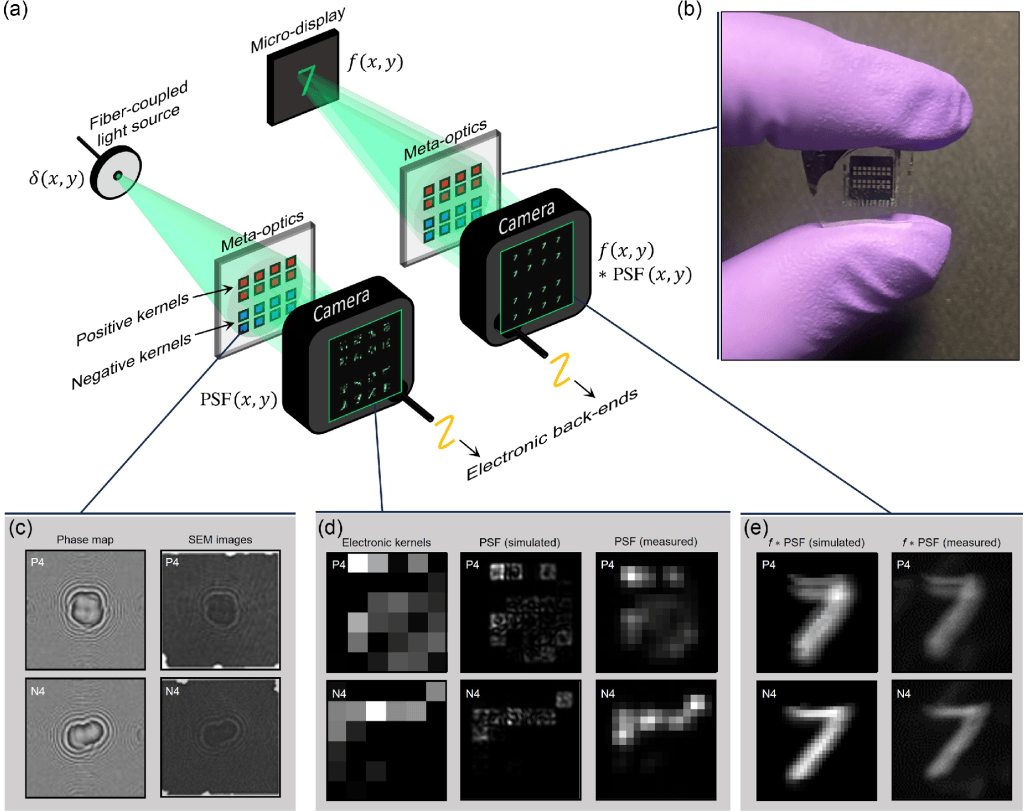
As an image formed by a meta-optic can be expressed as a convolution of its PSF with the object scene, the PSF can also be thought of as a convolutional kernel. For coherent light, the amplitude and phase of the PSF can encode a complex-valued kernel, whereas with incoherent light the intensity distribution can encode a non-negative kernel. With incoherent light, it’s possible to extend to negative-valued kernel functions by splitting the kernel into a positive and negative part, implementing both as positive-valued PSFs, and then subtracting the result after sensor capture—this approach is based on bipolar synthesis techniques developed prior to the work in meta-optics in the past couple decades. In any case, in thinking of PSFs from this perspective, this presents a compelling design opportunity for AI vision applications using meta-optics.
Convolutional neural networks are one of the workhorses of state-of-the-art vision AI networks, useful for image classification, object detection, and segmentation tasks with high accuracy. These AI models typically entail a large number of convolution operations that are implemented electronically, typically on graphics processing units (GPUs). Depending on the exact network design and target application, it’s not uncommon for there to be many hundreds of convolution operations performed. GPUs are well suited to these types of applications, but these calculations are still very power intensive.
In edge computing inference cases (e.g., a battery-operated security system, wildlife cameras, or robotic sensors), where all processing is to happen locally with an onboard processor (e.g., an edge-deployable GPU), the power budget is often quite constrained. This severely limits model complexity and therefore the achievable task performance and real-time operation (e.g., in terms of image classification accuracy).
As meta-optics are highly amenable to implementing array-based lens architectures for simultaneous capture of multiple sub-images, these components can be used to implement parallelized, all-optical convolution operations efficiently. In this paradigm, an array of meta-optics implements a single layer of convolutions, functioning as a pre-processor to extract convolutional features that then undergo subsequent digital processing with additional neural network layers. These architectures are often referred to as optical-digital hybrid networks, with the optical portion serving as a low-level feature encoder. Experimental demonstrations have shown competitive accuracies with AlexNet in a laboratory environment while reducing the required multiply-and-accumulate (MAC) operations by an order of magnitude.
While promising, there are still several practical challenges with this approach. In current implementations, these architectures are limited to implementing a single layer of convolutions, whereas most convolutional neural networks to date comprise many subsequent layers of cascaded convolutions with nonlinear operations sandwiched between. This architectural change arises from the fact that it is very challenging to achieve an optical nonlinearity, which would be a requirement to mimic the functionality of electronic neural networks more holistically. There are workarounds to this by training the optical-digital hybrid such that only convolution operations are performed in the first layer, and subsequent layers comprise different operators that are not as well suited to optical implementation.
Another challenge is that from a systems perspective, while optical-digital hybrid networks can reduce total MAC operations, the camera sensor power itself is often quite large and if the number of convolutional channels required is high, this could increase the required pixel count. Designers need to account for this to ensure channel size and the number of kernels is carefully balanced to stay within the system’s power budget.
If these challenges are appropriately contended with, PSF-engineered meta-optics offer a pathway to offloading compute to the optical domain as means to increase model complexity without increasing power budget. This could be useful in vision AI edge systems or in other situations where low-power, real-time vision processing is critical.
Summary
The point spread function is a common means of characterizing imaging system performance. Conventionally, optical designers will aim to make the PSF as compact as possible, which often leads to enhancements in MTF; however, other types of PSFs exploiting multiple intensity lobes and complex intensity patterns can be useful for extending depth of focus, discriminating depth and spectral content, and extracting convolutional features from scenes.
Metasurfaces offer a convenient platform for implementing a diverse range of different types of PSFs, owing to their subwavelength period enabling more complex and higher resolution PSF features and their ability to support freeform, asymmetric profiles that are more costly and challenging to realize with other means (e.g., sag profiles or conventional diffractive optics). Oftentimes, when utilizing a PSF-engineered component, these elements are paired with postprocessing software in order to extract and synthesize information. Designers interested in exploiting PSF-engineered meta-optics need to holistically balance system considerations in terms of latency, power, and any added performance benefit from the meta-optic.
References
Dowski Jr, Edward R., and W. Thomas Cathey. “Extended depth of field through wave-front coding.” Applied optics 34.11 (1995): 1859-1866.
Cathey, W. Thomas, and Edward R. Dowski. “New paradigm for imaging systems.” Applied optics 41.29 (2002): 6080-6092.
Wach, Hans B., Edward R. Dowski Jr, and W. Thomas Cathey. “Control of chromatic focal shift through wave-front coding.” Applied Optics 37.23 (1998): 5359-5367.
Piestun, Rafael, Yoav Y. Schechner, and Joseph Shamir. “Propagation-invariant wave fields with finite energy.” Journal of the Optical Society of America A 17.2 (2000): 294-303.
Greengard, Adam, Yoav Y. Schechner, and Rafael Piestun. “Depth from diffracted rotation.” Optics letters 31.2 (2006): 181-183.
Quirin, Sean, and Rafael Piestun. “Depth estimation and image recovery using broadband, incoherent illumination with engineered point spread functions.” Applied optics 52.1 (2013): A367-A376.
Colburn, Shane, Alan Zhan, and Arka Majumdar. “Metasurface optics for full-color computational imaging.” Science advances 4.2 (2018): eaar2114.
Colburn, Shane, and Arka Majumdar. “Metasurface generation of paired accelerating and rotating optical beams for passive ranging and scene reconstruction.” Acs Photonics 7.6 (2020): 1529-1536.
Colburn, Shane, and Arka Majumdar. “Simultaneous achromatic and varifocal imaging with quartic metasurfaces in the visible.” ACS Photonics 7.1 (2019): 120-127.
Huang, Luocheng, et al. “Design and analysis of extended depth of focus metalenses for achromatic computational imaging.” Photonics Research 8.10 (2020): 1613-1623.
Froch, Johannes E., et al. “Dual band computational infrared spectroscopy via large aperture meta-optics.” ACS Photonics 10.4 (2022): 986-992.
Fröch, Johannes E., et al. “Beating spectral bandwidth limits for large aperture broadband nano-optics.” Nature communications 16.1 (2025): 3025.
Whitehead, James EM, et al. “Fast extended depth of focus meta-optics for varifocal functionality.” Photonics Research 10.3 (2022): 828-833.
Tseng, Ethan, et al. “Neural nano-optics for high-quality thin lens imaging.” Nature communications 12.1 (2021): 6493.
Trabka, Eugene A., and Paul G. Roetling. “Image transformations for pattern recognition using incoherent illumination and bipolar aperture masks.” Journal of the Optical Society of America 54.10 (1964): 1242-1252.
Burgos, Carlos Mauricio Villegas, et al. “Design framework for metasurface optics-based convolutional neural networks.” Applied Optics 60.15 (2021): 4356-4365.
Wirth-Singh, Anna, et al. “Compressed meta-optical encoder for image classification.” Advanced Photonics Nexus 4.2 (2025): 026009-026009.
Choi, Minho, et al. “Transferable polychromatic optical encoder for neural networks.” Nature Communications 16.1 (2025): 5623.
Wei, Kaixuan, et al. “Spatially varying nanophotonic neural networks.” Science Advances 10.45 (2024): eadp0391.
Goodman, Joseph W. Introduction to Fourier optics. Roberts and Company publishers, 2005.
Xia, Chunwei, et al. “DNNTune: Automatic benchmarking DNN models for mobile-cloud computing.” ACM Transactions on Architecture and Code Optimization (TACO) 16.4 (2019): 1-26.
Heide, Felix, et al. “High-quality computational imaging through simple lenses.” ACM Transactions on Graphics (ToG) 32.5 (2013): 1-14.