
Key Points:
- The ability to manipulate and engineer distinct responses for different incident polarizations is a powerful capability that metasurfaces offer compared to conventional, scalar regime diffractive optics. Polarization-enhanced meta-atom designs have potential applications in imaging systems, sensors, and displays
- Central to this capability is asymmetry in meta-atom design, which can facilitate excitation of different modes within subwavelength gratings under different polarizations, ultimately giving rise to distinct phase and amplitude responses in transmission and reflection
- While a number of different meta-atom designs can provide multifunctional capabilities, allowing for distinct, polarization-based behavior (e.g., focal splitting, or polarization-switchable holograms), some designs are often more practical than others owing to fabrication constraints and optical performance limitations
Overview
One of the more unique aspects of metasurfaces is their ability to manipulate polarization at subwavelength scale. Compared to conventional, multi-level diffractive optics that operate in the scalar regime, meta-atom designs that exhibit asymmetry are capable of providing distinct functionalities for different incident polarization states. This can be a powerful capability enabling functionalities that typically would require multiple components, but that are possible to implement with a single metasurface.
In the past couple of decades, a large body of work on metasurfaces and subwavelength blazed gratings has investigated different materials, design strategies, and applications for polarization-enhanced meta-optic designs. In this article, we will not exhaustively detail all of these and the different embodiments of these innovations. Instead, we will primarily provide a concise overview of some of the key design considerations and challenges with polarization-manipulating metasurfaces, including an emphasis on best practices and tradeoffs.
Meta-atom Asymmetry is Central to Unlocking Polarization-Controlled Functionality
Meta-atom design is central to any polarization-enhanced functionality with a metasurface. Assuming operation at normal incidence, if a meta-atom exhibits C4 symmetry (i.e., if it looks identical if rotated 90 degrees within its unit cell), then the meta-atom will be polarization insensitive. This is because any normally incident polarization state can be decomposed into a linear combination of horizontally and vertically polarized sources, and with C4 symmetry the resultant transmission and reflection behavior will be the same up to a rotation of the output field distribution. A square cross section or circular cross section meta-atom are examples of this.
With meta-atom asymmetry, however, behavior varies for different incident polarizations. For a periodic grating (e.g., comprising an array of meta-atoms), physically, this means that even with a 90-degree rotation, the set of modes excited by a horizontally polarized source will not be the same as those of a vertically polarized source, ultimately giving rise to differences in the transmission and reflection coefficients of the grating.

Meta-atom Design for Polarization Multi-functionality Follows Similar Procedures as Standard Meta-atoms, but the Lookup Table Has More Design Parameters

A typical design process for polarization meta-atoms proceeds as follows. Say you have an application where you want to have distinct functionality for incident horizontal and vertical polarizations (e.g., both should focus light to a spot but these spots are to be transversely offset at the focal plane by some fixed distance). In this case, you need to select a meta-atom geometry that is both fabricable and that will provide the necessary asymmetry to facilitate this distinct polarization behavior. One example of this is a rectangular meta-atom, where the x and y lengths of the nanostructure are in general not the same.

A designer can then sweep these two design parameters, the x and y feature widths, over a range of feature sizes for a given unit cell period and thickness. Note that this is often an iterative process, as the thickness and period can significantly affect the performance of the meta-atoms as well as fabrication feasibility. We refer the reader to our earlier post on metasurface fabrication and the basics of meta-atom design for some general best practices and design guidance.

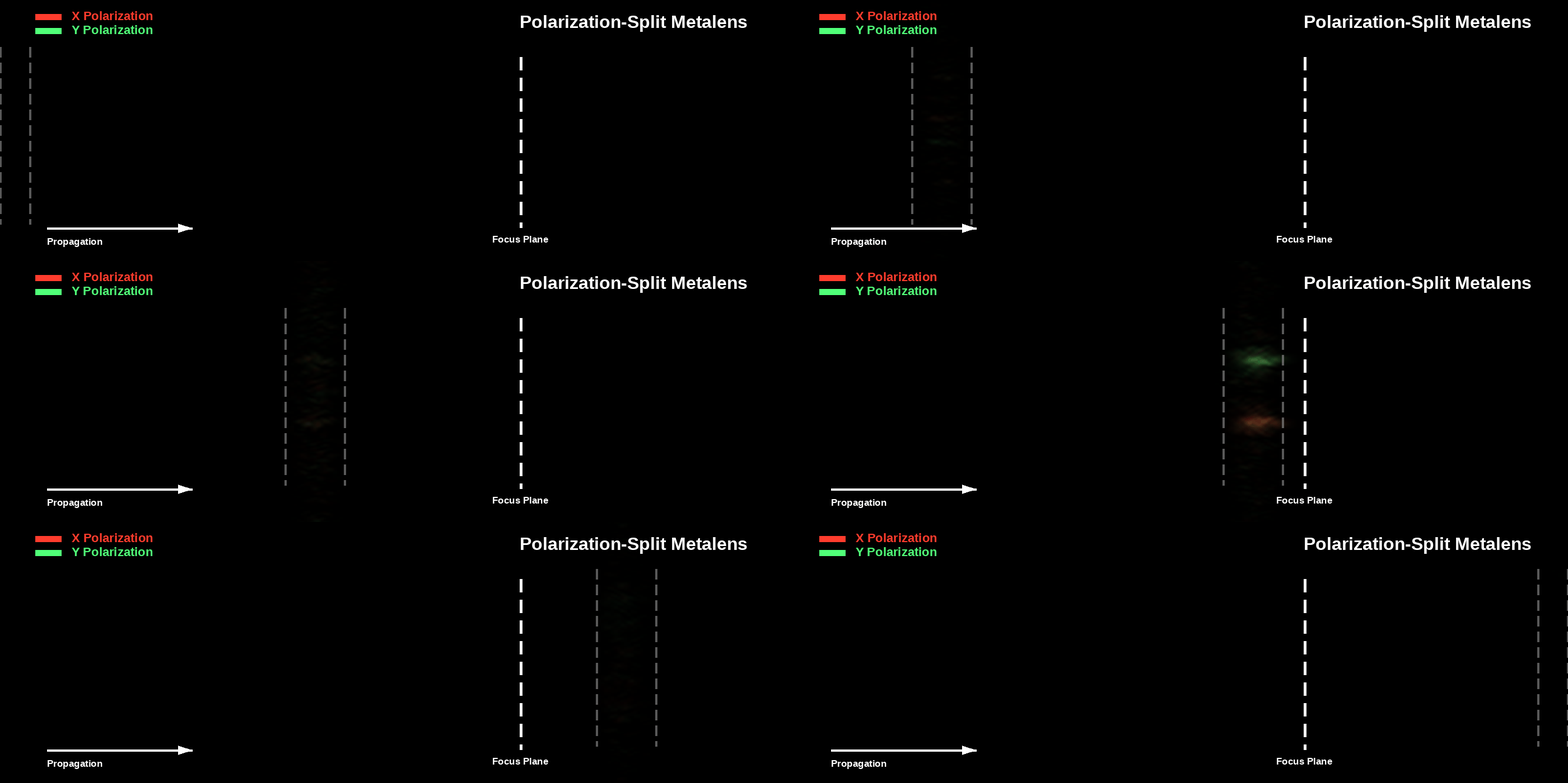
Once the designer has completed the 2D design parameter sweep over x and y feature widths for, in this example, a rectangular meta-atom design, you can determine an inverse mapping such that for an arbitrary pair of phase shifts desired for x and y polarizations, you can determine what feature dimensions x and y will yield those. Diffracted intensity of a pulse of light from a finite-difference time-domain (FDTD) simulation of a polarization-multiplexed metalens is shown in the GIF below, with X and Y polarizations depicted in red and green, respectively.

A GIF of the diffracted intensity of an incident pulse of light with equally weighted X and Y polarization inputs. The metasurface design here was engineered to focus each polarization to different transverse positions offset from the central optical axis. The design was based on a rectangular nanorod utilizing the transmission coefficient data in the earlier figure in this article. The metalens design was simulated via the finite-difference time-domain method to extract the near fields, which were then propagated via the angular spectrum method.
Angle of Incidence Matters
In the discussion so far, we’ve been assuming normal incidence. The case looks different for oblique incidence, as even with C4 symmetric meta-atoms, transverse-electric (TE) and transverse magnetic (TM) light can excite different modes. TE polarization tends to be less sensitive to angle of incidence compared to TM, because with TM polarization, there will be a component of the electric field along the axial direction of the meta-atom. This means that as you deviate from normal incidence, TM polarization begins to excite axial modes that TE would not, which gives rise to differences in transmission and reflection behavior. Kamali and coauthors provide a great depiction of this behavior, showing sample mode profiles for TE and TM sources at different oblique incidences. For polarization-enhanced meta-atom designs that are already asymmetric, the same will be true, where at oblique incidence TM polarization can excite axial nanopost modes.

Similar Design Considerations and Constraints for Polarization-Insensitive Meta-atoms Still Apply
As with other types of meta-atoms that are intended to be polarization insensitive, there are several design considerations that need to be kept in mind. Firstly, refractive index will play a key role in determining performance. Higher indices will tend to confine modes better within the nanostructure itself, and tend to lead to higher diffraction efficiencies. With polarization meta-atoms, the same is true. At very low indices, as with materials such as silicion nitride or silicon dioxide, it can be challenging to achieve high-performance polarization multiplexing relative to what is possible with higher index counterparts based on materials such as silicon, titanium dioxide, or niobium pentoxide.
Additionally, polarization meta-atom designs that rely on fine or very sharp features that exhibit high nominal performance may perform poorly once fabricated. Sharp features tend to be rounded during the manufacturing process. As such, elliptical or curved polarization meta-atoms tend to be more common and robust to imperfections compared to rectangular geometries, though demonstrations with rectangular meta-atoms do still exist.
Applications
Polarization-sensitive metasurfaces are useful because they can make a single optical surface perform different functions for different input or output polarization states. This can be exploited for compact polarization optics, polarimetric imaging, AR/VR displays, beam splitting, and multifunctional imaging systems where polarization is used as an additional information channel. For example, Arbabi and coauthors demonstrated a dielectric metasurface platform capable of controlling phase and polarization, including components where a single metasurface achieved functionality that would typically require a Wollaston prism and two mirrors with sensitive free-space alignment. More recently, commercial efforts such as Metalenz’ Polar ID have highlighted how polarization-sensitive meta-optics can be used for compact sensing and authentication. As with other metasurface approaches, the added functionality needs to be balanced against fabrication complexity, efficiency, bandwidth, stray light, and system-level integration constraints.
Summary
As a platform, the capability for manipulating and exploiting polarization is one of the most unique and useful characteristics of meta-optics. Asymmetry in meta-atom design is key to this capability, which enables engineering of different modal responses and couplings, giving rise to distinct phase and amplitude responses in both reflection and transmission for different polarization states. Through careful design that considers refractive index contrast, phase gradient, fabrication constraints, and other meta-atom design best practices, one can generate a multi-parameter phase lookup table that facilitates designing polarization-multiplexed meta-optics, whereby distinct functionality is achievable for different incident polarizations. Polarization-enhanced meta-atoms are already being commercialized, and they have a number of potential applications in both imaging and non-imaging systems.
References
Bomzon, Ze’ev, Vladimir Kleiner, and Erez Hasman. “Formation of radially and azimuthally polarized light using space-variant subwavelength metal stripe gratings.” Applied Physics Letters 79.11 (2001): 1587-1589.
Hasman, Erez, et al. “Polarization dependent focusing lens by use of quantized Pancharatnam–Berry phase diffractive optics.” Applied physics letters 82.3 (2003): 328-330.
Lin, Dianmin, et al. “Dielectric gradient metasurface optical elements.” science 345.6194 (2014): 298-302.
Arbabi, Amir, et al. “Dielectric metasurfaces for complete control of phase and polarization with subwavelength spatial resolution and high transmission.” Nature nanotechnology 10.11 (2015): 937-943.
Wen, Dandan, et al. “Helicity multiplexed broadband metasurface holograms.” Nature communications 6.1 (2015): 8241.
Wen, Dandan, et al. “Metasurface for characterization of the polarization state of light.” Optics express 23.8 (2015): 10272-10281.
Arbabi, Amir, et al. “Miniature optical planar camera based on a wide-angle metasurface doublet corrected for monochromatic aberrations.” Nature communications 7.1 (2016): 13682.
Kamali, Seyedeh Mahsa, et al. “Decoupling optical function and geometrical form using conformal flexible dielectric metasurfaces.” Nature communications 7.1 (2016): 11618.
Khorasaninejad, M., et al. “Multispectral chiral imaging with a metalens.” Nano letters 16.7 (2016): 4595-4600.
Balthasar Mueller, J. P., Rubin, N. A., Devlin, R. C., Groever, B., & Capasso, F. (2017). Metasurface polarization optics: independent phase control of arbitrary orthogonal states of polarization. Physical review letters, 118(11), 113901.
Arbabi, Ehsan, et al. “Full-Stokes imaging polarimetry using dielectric metasurfaces.” Acs Photonics 5.8 (2018): 3132-3140.
Teng, Shuyun, et al. “Conversion between polarization states based on a metasurface.” Photonics Research 7.3 (2019): 246-250.
Dorrah, Ahmed H., et al. “Metasurface optics for on-demand polarization transformations along the optical path.” Nature Photonics 15.4 (2021): 287-296.
Huang, Zhaorui, et al. “High-resolution metalens imaging polarimetry.” Nano letters 23.23 (2023): 10991-10997.