
Key Points:
- The novelty and utility of metasurfaces are often debated and can vary significantly depending on use case
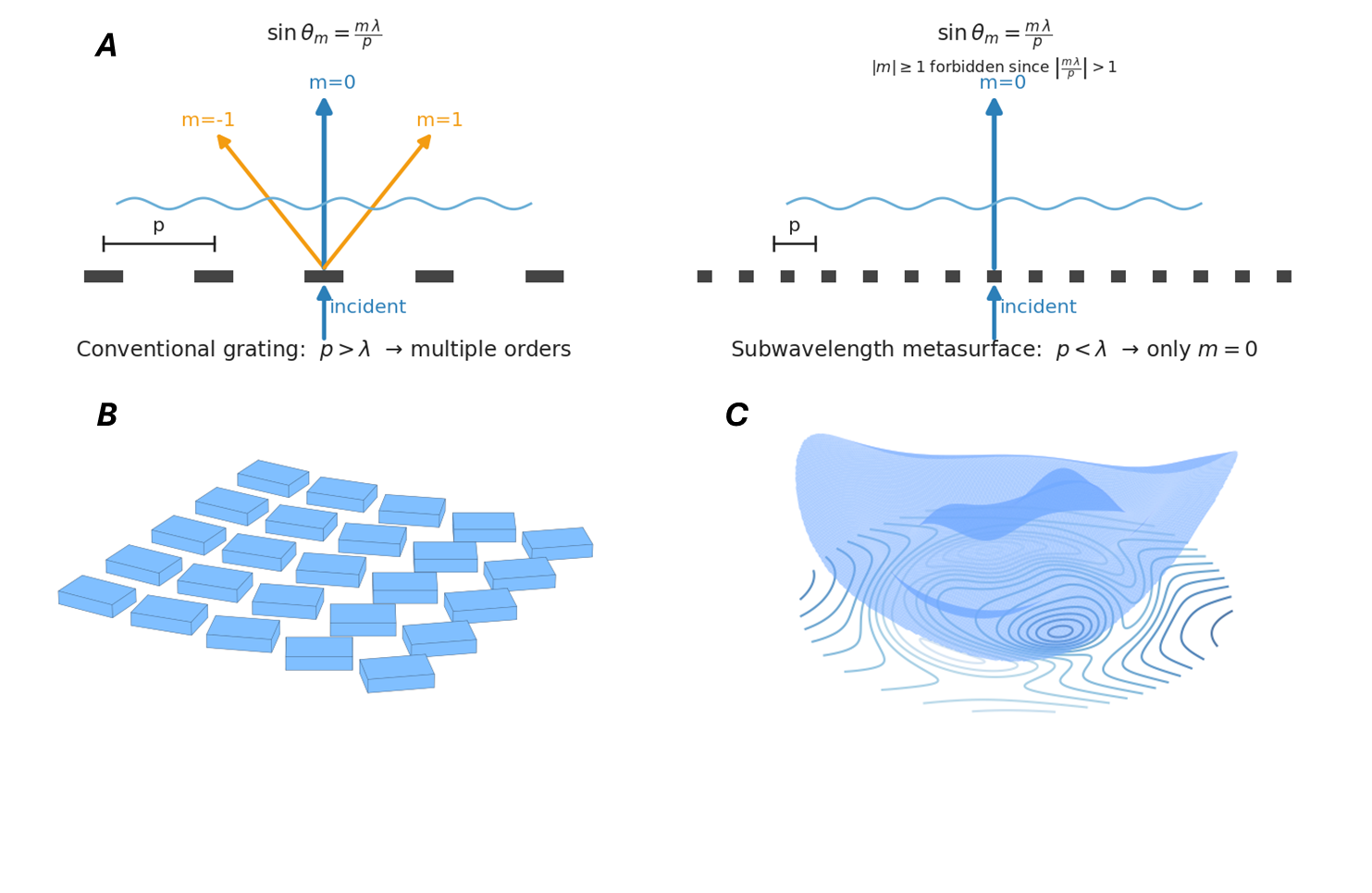
- Relative to existing diffractive and refractive components, metasurfaces can offer enhancements in space-bandwidth product and lightfield parameter manipulation (i.e., multiplexing across polarization, wavevector, and frequency)
- Metasurfaces show promise where high numerical aperture is necessary relative to traditional diffractives, when freeform surfaces are challenging to implement with alternatives, and when there are opportunities to collapse multiple optics into a single surface (e.g., combining polarization optics with lenses)
Introduction
Whether for fundamental or applied research, or when considering commercialization, a question of great practical significance for metasurfaces is “what are they actually good for?”. The answer to this will depend substantially on who you ask, partly because everyone has their own biases and vested interests, partly because there are still open questions and unsolved design, manufacturing, and commercialization challenges for flat optics.
There are really three categories of responses to the question. The first is quite exuberant and optimistic, touting numerous benefits, that flat optics will revolutionize almost all optical technologies and that the end of refractive optics is approaching. The second is the opposite, and is wholly dismissive of these components, claiming that they have nothing new to offer at all and the whole discipline is overhyped and oversold. This is also complicated by the fact that “metasurfaces” are not “new” but that the term “metasurface” is relatively new. Both of these types of responses do a disservice not only to researchers within the metasurface community, but also to a much wider group of stakeholders (e.g., investors, partner companies, researchers in complementary fields, and the general public) that could benefit from metasurface-based technologies in applications where they’re truly impactful, or could save energy and money by not investing time and resources into oversold claims.
The third category of answers to the question “what are they actually good for?”, which aligns with our perspective, is that it’s somewhere in between the first two answers. Overwhelmingly most of the community falls somewhere between these two responses.
Positioning Meta-optics Relative to Alternatives
On the one hand, when considering optical metasurfaces as a subset of diffractive optical elements, one can claim that they don’t really offer anything new. Metasurfaces are typically treated as phase masks and diffractive optical elements that can do this have existed and been commercially available for decades. This is not completely fair though. Metasurfaces are phase masks and are a type of diffractive optic, but their characteristic subwavelength pitch endows them with some subtle advantages (and also disadvantages, depending on design requirements).
The subwavelength spacing alters the mode structure of the grating, limiting but not eliminating diffraction sent to higher orders. At the same time, and arguably a more important aspect of the subwavelength spacing, is that this enables implementation of phase profiles with higher numerical aperture—or more generally, a higher phase gradient. Equivalently this means that a metasurface as an optical component has more degrees of freedom (i.e., a higher space-bandwidth product). This is a powerful, albeit sometimes subtle, benefit that metasurfaces offer.
For imaging applications, this higher space-bandwidth product enables faster lens designs that can produce brighter images. When well corrected, these high-NA lenses can also enhance spatial resolution. In beamshaping applications (e.g., in semiconductor lithography), where diffractive optical elements first found product-market fit decades ago, this high-NA capability further expands the range of possible point spread functions and intensity profiles that can be generated. In this manner, there’s an argument for the case that meta-optics are useful for applications where existing diffractive optical elements already excel. Perhaps there’s also an argument for the case of using meta-optics for single-wavelength beamshaping optics that are traditionally achieved with refractives but that are limited in performance due to constraints on space-bandwidth product.
Freeform Optics
When utilized solely as a phase-shifting element, a metasurface really is not all that different from a traditional diffractive optic (e.g., a kinoform, phased Fresnel lens, or binary optic), except in that it can offer higher NA, which is a real advantage. An application that metasurfaces can be practically useful for in terms of phase-shifting elements is for freeform optics. In freeforms, asymmetry and higher order polynomial forms are standard, and it is precisely these features that enable them to reduce system form factor and impart unconventional functionalities. At the same time, because of steep surface slopes and asymmetry in sag profiles, it’s often challenging and expensive to make refractive freeform surfaces. With flat metasurface optics, whether the surface is freeform or fully rotationally symmetric, it makes no difference—the fabrication complexity and cost would be the same and based on a single lithography step.
Mode Engineering and Lightfield Parameters
More broadly though, when considering what metasurfaces are good for, it’s worth examining what makes metasurfaces unique and different from existing alternatives. One key advantage is the ability to engineer scatterers that exhibit far richer characteristics in terms of reflection and transmission coefficient (i.e., both amplitude and phase) as a function of frequency, wavevector, and polarization. At the length scales of the phase shifters of typical diffractive optics, that are in excess of a wavelength, the associated modes limit the types of resonant behavior, constraining the types of functionality that can be implemented. With subwavelength patterning, however, you can engineer more complicated sets of modes that can couple amongst themselves, giving rise to supermodes with high-quality factor resonances, angle-dependent behavior, and polarization-multiplexed functionality. The variety of scatterer shapes, geometries, and the potential to extend to multi-layer scatterers enables a more diverse set of responses. Of course, in practice, it’s not trivial to design these scatterers, but the potential is there, whereas traditional diffractive optics by definition cannot exploit the richness of the mode structure associated with subwavelength patterning.
Whether all these unique capabilities in terms of scatterer design will find product-market fit is not entirely clear still. Polarization manipulation exploiting complex meta-atoms is a powerful feature that metasurfaces offer and the company Metalenz has made great progress in this direction. Ultimately, however, broad commercial adoption of any metasurface technology may also have more to do with markets than any underlying technical aspects of meta-optics.
Summary
In summary, metasurfaces are optical elements that provide some unique functionality, particularly in terms of enhanced space-bandwidth product and lightfield parameter multiplexing capabilities (i.e., with respect to polarization, wavevector, and frequency) relative to traditional diffractive optics. These enhancements can benefit use cases where one needs higher numerical aperture or fast lenses compared to what other diffractives offer, where freeform surfaces are impactful, and where existing implementations require multiple optics that could be imparted with a single, flat meta-optic. That being said, metasurfaces have their own limitations, notably in terms of efficiency, stray light, and chromatic aberration. As such, it’s necessary to evaluate on a case-by-case basis and to compare rigorously with state-of-the-art alternatives to ascertain if a metasurface-based solution is appropriate for a given use case.
Additional References
Engelberg, Jacob, and Uriel Levy. “The advantages of metalenses over diffractive lenses.” Nature communications 11.1 (2020): 1991.
Arbabi, Amir, and Andrei Faraon. “On” Inconsistencies of metalens performance and comparison with conventional diffractive optics”.” arXiv preprint arXiv:2410.12559 (2024).
Menon, Rajesh, and Berardi Sensale-Rodriguez. “Inconsistencies of metalens performance and comparison with conventional diffractive optics.” Nature Photonics 17.11 (2023): 923-924.
Zhan, Alan, et al. “Metasurface freeform nanophotonics.” Scientific reports 7.1 (2017): 1673.
Mait, Joseph N., et al. “Exploiting metamaterial characteristics for computational imaging.” Flat Optics: Components to Systems. Optica Publishing Group, 2021.