
Key Points
- Freeform elements are optical surfaces lacking an axis of rotational symmetry that can facilitate correction of higher order aberration terms, but these components often introduce additional challenges in manufacturing complexity, cost, and yield
- Metasurfaces offer a versatile platform for imparting asymmetric wavefront transformations in an ultrathin and flat form factor, where higher order terms and changes in polynomial bases (e.g., based on polynomials such as Zernike, Q-type, etc.) have minimal impact on manufacturing complexity. Several demonstrations of freeform meta-optics exist, including some in folded geometries, as pairs of actuated conjugate plates, and in conjunction with refractive freeform elements
- When asymmetry in an optical layout can bring design advantages, but the cost of implementing and integrating multiple complex sag profiles is prohibitive, metasurfaces may offer an alternative platform. These considerations need to be balanced with the bandwidth limitations and stray light challenges associated with meta-optical components
Overview
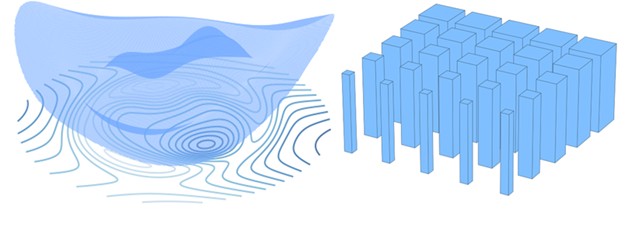
Freeform optics traditionally refers to optical surfaces that depart from rotational symmetry and use sag profiles that vary along multiple axes. This broader design space enables aberration correction, compact form factor, and beamshaping or imaging functionalities that are difficult or impossible with symmetric, low-order surfaces. Rolland and co-authors formalized this idea through defining them as exhibiting three or more independent axes of variation. This allows surfaces to vary in ways that depart from typical symmetry constraints and expands the set of achievable wavefront transformations.
It’s worthwhile distinguishing this system-level meaning of “freeform” from the way the term is sometimes used in the metasurface community. In traditional imaging and illumination design, a freeform optical element refers to a macroscopic profile. In metasurface literature, however, “freeform” has also been used to describe scatterer-level, topology-optimized designs at the wavelength scale. These serve different purposes. The former shapes a wavefront’s phase across millimeters or centimeters, whereas the latter tailors local scattering behavior to maximize efficiency or to encode specific lightfield responses. Here, we focus on the former definition (i.e., macroscopic freeform surface profiles), rather than “freeform” meta-atom designs.
Historically, freeform optics became viable as fabrication techniques improved, making it possible to realize nonsymmetric surfaces with acceptable yield. This has facilitated enhancements in fields of view, aberration control, and more compact system geometries. Once symmetry constraints are lifted, designers can pursue designs that more closely provide the desired performance, rather than the one that is easiest to manufacture.
Metasurfaces extend these ideas in meaningful ways. Because they impose phase via subwavelength patterning rather than physical sag, they can implement high-order or rotationally asymmetric phase functions without the manufacturing challenges associated with steep surfaces. They also allow phase, polarization, and spectral control to coexist on a single interface, collapsing what would potentially require multiple separate optics paired with freeform elements into a flat surface, in some cases with multiple meta-optics in a folded waveguide architecture.
In this article, we’ll briefly touch on the history of freeform optics and describe how metasurfaces may have a key role to play in the development of high-performance freeform components and systems.
Background

Freeform optics emerged as fabrication and metrology improved to the point where surfaces without rotational symmetry could be produced with acceptable accuracy and yield. Early efforts showed that allowing surfaces to vary along both primary axes, rather than only radially, could reduce the number of elements required in wide-field or compact systems. Tunable concepts such as sliding plate lenses (e.g., Alvarez lenses) demonstrated that introducing controlled polynomial variations in the surface profile can provide new degrees of freedom for aberration balancing and focal adjustment. Over time, designers adopted a variety of polynomial bases, such as Zernike, Q-type, and XY polynomials, which make it easier to represent and control higher order behavior. A central idea is that freeform design expands the available solution space by adding what some describe as a third axis of variation, allowing the optical surface to more closely match the phase function required for a specific imaging or beamshaping task.
In parallel, researchers explored how intentional wavefront shaping can support computational imaging. Wavefront coding techniques used tailored phase profiles to extend depth of field or provide resilience to system misalignments. Other works have employed higher order polynomials, including sixth order and above, to shape the spatial frequency content of the captured image. These approaches often relied on paired conjugate plates or related designs that enable tunable wavefront coding when combined with deconvolution or other post-processing algorithms. The goal in each case was to create an optical system that does not simply form an image directly, but instead produces an intermediate representation that a reconstruction algorithm can invert with improved robustness or flexibility.
Advantages of Metasurfaces for Freeform Surface Engineering

In what way can metasurfaces facilitate freeform optics? There are really two key properties they have that make them advantageous, which are both ultimately connected to manufacturing feasibility. The first is that in being flat optics, metasurfaces can impart phase profiles exhibiting asymmetry and higher order polynomials without requiring a complex sag profile, which is often challenging and expensive to fabricate. Metasurface fabrication is not affected by the designer’s selection of a Zernike, Q-polynomial, radial basis function, or other parameterization, as long as the unit cell size for the meta-atoms is small enough to sufficiently sample the target function. While changing polynomial bases with refractive elements can have significant impacts on manufacturing feasibility, potentially requiring changes in tooling, yield, and unit cost, with a metasurface all these considerations remain largely the same.
A second major advantage is that metasurfaces support a high space-bandwidth product, which is a direct consequence of their subwavelength unit cell size. This facilitates higher gradient phase functions tied to higher order terms, which are common with freeform surface design. Similar arguments can be made for binary optics and other diffractive components, but as the distinguishing property of a metasurface is its subwavelength period, conventional diffractive elements by definition cannot support as high a space-bandwidth product.
Examples of Freeform Metasurface Elements


There have been several demonstrations of metasurface-based freeform optics, wherein asymmetry in the phase function design and higher order terms are intentionally exploited for a target application. One example of this is metasurface designs utilizing X-Y polynomials for generating Airy beams and related beam profiles with cubic and quartic phase polynomials. An Airy beam is a special type of beamshape that belongs to a class of self-healing beams that exhibit an intensity profile that is propagation invariant (i.e., it maintains itself as it propagates through space, up to a scale factor). These types of beams have applications in micro-machining, optical trapping, and microscopy and are typically generated with an element that exhibits a cubic phase function. Metasurface-based cubic phase plates have been shown multiple times experimentally at different wavelength ranges. The figure above depicts the phase map of a cubic phase meta-optic as well as a simulation of beam propagation, demonstrating the characteristic parabolic, accelerating trajectory of the central lobe.
There have also been works utilizing metasurfaces in conjunction with refractive freeform surfaces, wherein there is an underlying curved surface upon which nanostructures forming a metasurface are applied. Several works have developed different formalisms for analyzing and evaluating these systems, including adapting the finite-difference time-domain to more accurately capture the physics of metasurfaces on curved boundaries. One experimental result developed a “metaform” element in which a metasurface fabricated via e-beam lithography on top of a freeform sag profile mitigated aberrations in a near-eye display.
Metasurface-based Conjugate Plate Systems

Several recent studies have shown that metasurfaces can implement the same types of freeform conjugate-plate designs that were traditionally done with bulk optics. One early demonstration used a pair of patterned dielectric plates to realize both a cubic phase element and an Alvarez-style tunable lens. By encoding the required phase functions into flat metasurfaces and shifting them laterally by only a small distance, the system achieved millimeter-scale focal tuning and produced an extended depth of field suitable for broadband imaging. This showed that polynomial phase functions, which normally require mechanically challenging surface shapes, can be produced on a thin patterned layer with reliable control.
Subsequent work expanded this idea by using conjugate metasurfaces with higher order phase profiles, specifically quartic terms, to enable varifocal and achromatic computational imaging systems. In these demonstrations, two plates with matched but opposite phase variations were shifted relative to one another to adjust focal length while keeping the point spread function nearly invariant across the visible spectrum. This allowed full-color imaging with a single deconvolution filter, highlighting how freeform metasurface designs can combine tunability with computational reconstruction.

One challenge with these types of systems is the need to keep the gap between conjugate plates small. The gap requirements will depend on the aperture size and operating wavelength. While technically the derived phase profiles assume zero gap, in practice it is often tolerable to maintain a gap on the order of microns to tens of microns for millimeter-scale devices. Significant deviations in the gap between plates, or introduction of tilt/tip misalignment can degrade performance, though these considerations are not all that different from alignment requirements for multi-element refractive systems.
Challenges and Opportunities
While metasurfaces offer a versatile platform for freeform surface engineering, either as flat optics or applied conformally to a refractive sag profile, there are still challenges. While fabrication is agnostic to the parameterization (i.e., the selection of a polynomial basis), higher order terms and steep phase gradients correlate with higher stray light, as locally each portion of the metasurface can be modelled as a beam deflector with a varying deflection angle with position. As the phase gradient increases, the associated deflection angle increases, impacting efficiency and sending more light to zero order. These effects can be mitigated with appropriate design and ensuring scatterers are selected to minimize zero order, but these issues need to be managed or accounted for one way or another. At the same time, a notable drawback of metasurfaces for freeform design is their chromatic aberration, which most of the time will limit these components to single wavelength or narrowband applications, though there are potential workarounds exploiting multiple cascaded metasurfaces to facilitate achromatic operation.
As previously noted by many others in the freeform optics community, the design and manufacturing of freeform elements is highly coupled. There has been significant development of metrology tools for evaluating refractive surface quality and fabrication errors. With metasurface freeforms, there will need to be further investments and development of metrology equipment to ensure accurate characterization of such elements at high throughput.

In cases where asymmetry is highly advantageous in optical design, and when the cost and complexity of a refractive freeform may preclude its use, metasurface-based freeforms may serve as a competitive alternative. Of particular relevance is the suitability of metasurfaces for folded systems as freeform systems are a natural fit for folded optics that lack an axis of rotational symmetry. With folded metasurface systems, multiple elements are fabricated on the same side of a substrate, akin to augmented reality waveguides, offering further cost reductions with a single lithography stage to build multiple optics simultaneously that have negligible element-to-element placement tolerances owing to these metasurfaces being on the same mask layer during fabrication; waveguide thickness is still an important factor and this parameter needs to be controlled carefully to ensure spacing between adjacent elements is within tolerance.
References
Wills, Stewart. “Freeform optics: notes from the revolution.” Optics and Photonics News 28.7 (2017): 34-41.
Rolland, Jannick P., et al. “Freeform optics for imaging.” Optica 8.2 (2021): 161-176.
Kern, Gina A., and Carlos R. Stroud. “16. The Freeform Optics Revolution.” A Jewel in the Crown II: Essays in Honor of the 90th Anniversary of the Institute of Optics University of Rochester. University of Rochester Press, 2020. 102-113.
Thompson, Kevin P., and Jannick P. Rolland. “Freeform optical surfaces: a revolution in imaging optical design.” Optics and Photonics News 23.6 (2012): 30-35.
Alvarez, Luis W., and William E. Humphrey. “Variable-power lens and system.” U.S. Patent No. 3,507,565. 21 Apr. 1970.
Dowski Jr, Edward R., and W. Thomas Cathey. “Extended depth of field through wave-front coding.” Applied optics 34.11 (1995): 1859-1866.
Ojeda-Castañeda, Jorge, José Enrique A. Landgrave, and Cristina M. Gómez-Sarabia. “Conjugate phase plate use in analysis of the frequency response of imaging systems designed for extended depth of field.” Applied optics 47.22 (2008): E99-E105.
Castro, Albertina, and Jorge Ojeda-Castañeda. “Asymmetric phase masks for extended depth of field.” Applied optics 43.17 (2004): 3474-3479.
Zhan, Alan, et al. “Metasurface freeform nanophotonics.” Scientific reports 7.1 (2017): 1673.
Colburn, Shane, Alan Zhan, and Arka Majumdar. “Metasurface-based freeform optics for biosensing and augmented reality systems.” CLEO: Applications and Technology. Optica Publishing Group, 2016.
Colburn, Shane, Alan Zhan, and Arka Majumdar. “Varifocal zoom imaging with large area focal length adjustable metalenses.” Optica 5.7 (2018): 825-831.
Colburn, Shane, and Arka Majumdar. “Simultaneous achromatic and varifocal imaging with quartic metasurfaces in the visible.” ACS Photonics 7.1 (2019): 120-127.
Wu, Kedi, et al. “Modelling of free-form conformal metasurfaces.” Nature communications 9.1 (2018): 3494.
Nikolov, Daniel K., et al. “Metaform optics: Bridging nanophotonics and freeform optics.” Science Advances 7.18 (2021): eabe5112.
Kumar, Sumit, Zhen Tong, and Xiangqian Jiang. “Advances in the design and manufacturing of novel freeform optics.” International Journal of Extreme Manufacturing 4.3 (2022): 032004.